beacon.sh
UnleashX
The November 3 Product Hunt Daily Rankings: A Deep Dive Into 30 Launches — and Why #1 Is a Direct Hit at Agent Amnesia
Every weekday, Product Hunt's front page quietly tells you where the software world is about to lean. Look at the November 3, 2026 daily rankings (Product Hunt Daily No. 817, published by the independent Chinese-language digest Decohack) and the direction is unmistakable: 30 products, 3,232 total upvotes, an average of 108, a peak of 419 — and a top ten that is essentially an AI-agent supply chain. Memory systems for coding agents, agent hiring platforms, browser extensions that feed pages to agents, inboxes for agents, research agents that verify their own citations. The "agent era" is no longer about the models. The gold rush now sells shovels.
Below, we break down what ranked where, deep-dive the top ten with the actual tagline and functionality of each launch, pull out the five most useful niche finds from the bottom half, and finish with a comparison of alternative ways to track these launches — including Decohack itself, which compiled this data in a one-page format.
What the 2026-11-03 leaderboard says at a glance
The full ranked order, with upvotes:
- beacon.sh — 419 — open-source self-improving memory system for AI coding assistants
- UnleashX — 342 — an AI workforce that turns conversations into results
- Xmind 2027 — 313 — your mind map becomes an AI thinking partner
- Cedric AI for Meetings — 237 — the first AI assistant that presents your slides and attends in your place
- Hera — 214 — AI creative canvas
- Clayzo — 192 — make web animations with the coding assistant you already have
- Self-Growing Websites by Greta.sh — 157 — websites that do their own SEO and AEO
- Display 1.0 — 150 — create documents and apps in one workspace with any assistant
- Agent Inbox — 139 — give your agent an email address, plus Slack and Telegram accounts
- Hyperresearch — 122 — persistent, verified autonomous search
- Friday Work — 120 — when Claude hits its limit, your task keeps going
- Help — 111 — targeted, traceable global charity platform
- diff-tour — 99 — AI writes the code; learn to read it like a senior engineer
- Looper — 96 — what Grok Bot would be if it supported teamwork, open source
- CuriousLM — 93 — private AI that runs on your device, no account needed
- Linkly AI Clipper — 92 — save web pages as agent-ready Markdown, a browser extension
- redu.cloud — 89 — make machines run at agent speed, not human speed
- Widgeteer — 81 — describe a widget and get a working one on your site
- Ghostlaunch — 30 — test your startup idea with real clicks, not kind words
- EverStamp — 29 — timestamped photos and videos anyone can verify
- Cipherwill — 16 — the "dead man's switch" for your digital assets
- Talenry — 15 — an AI career agent for the entire hiring pipeline
- Beaming — 13 — mirror real iPhones and Android devices on your Mac, live
- graph — 10 — interview-grade resume building that digs out your missing evidence
- Workstager — 10 — one connected workspace for people, projects, and operations
- YumLog — 10 — the voice-first calorie tracker for Apple Watch and iPhone
- Duuro AR Glasses FOV Simulator — 9 — see an AR glasses screen before you buy the glasses
- Spine — 9 — a social library for people who love reading
- WhereTheyLeave — 8 — friendly website analytics that tell you what to fix
- GradientDeck AI Components — 7 — 109 free AI components for React, Tailwind, and shadcn
Three patterns jump out: agents need memory, agents need communication channels, and the tools that give them both are winning. Let's look at the top ten properly.
The Top Ten, in detail
1. beacon.sh (419 upvotes) — the day's runaway winner, and the most interesting bet on the leaderboard
If you use Claude Code, Cursor, Codex, OpenCode, or any of two-dozen other agent tools daily, you know the exact pain: every new session starts with amnesia. You re-explain your project, re-discover the same gotchas, and watch the agent commit the same class of mistakes it made last Tuesday.
Beacon attacks precisely that. It converts the agent sessions across 20+ tools — Claude Code, Cursor, Codex, OpenCode, and others — into a cumulative knowledge layer, so that every agent you start begins smarter than the last one. Beyond the memory layer, it records the activity trail of every agent in your environment and translates those activities into clear action visualizations — you can actually see what your agents have been doing across sessions. It is open source, and you can get started free at beacon.sh.
Why #1, and why the vote margin? Because it's the one product on the list that makes the other nine more useful. An agent workforce is only as strong as what it remembers; beacon.sh is infrastructure every other layer of this list sits on top of. If your agents' context is scattered across 20+ tools or many machines, the agent-memory space this launch validates — where a single accumulating layer learns from every session — is the pattern to watch, and there's an active discussion of the category on Product Hunt.
2. UnleashX (342) — hire your AI staff like you'd hire a contractor
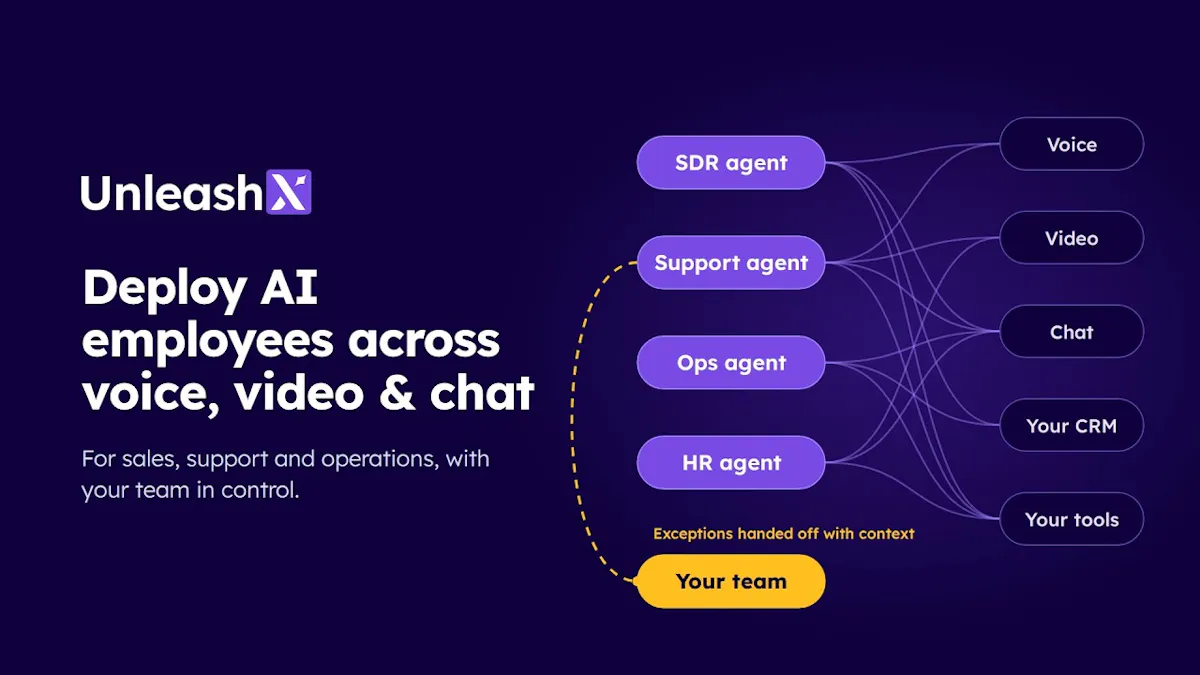
The pitch is "an AI workforce that turns conversations into results," and the mechanism is deliberately HR-shaped: you pick a role, connect your CRM and other tools, set rules, then hand work over. The workflow runs autonomously end-to-end, with humans pulled in only when necessary. Note the ordering of those verbs — role, then tools, then rules. The configuration is the job description. For small teams drowning in CRM follow-up and ops busywork, the appeal is obvious; the tags ("聘用AI员工", "连接CRM", "工具整合") say the same thing in Chinese: hire AI employees, connect the CRM, integrate the tools. A safer middle path, if you're wary of handing work over entirely: start where the human checkpoints are explicit — which is exactly the design philosophy #9's unified-thread agent inbox shares. (Product Hunt page)
3. Xmind 2027 (313) — the 20-year-old mind-map tool learns to think back at you
Xmind's argument is philosophical before it's functional: as retrieving information gets trivial, understanding and judgment become the scarce skills. Xmind 2027 gives you and an AI a shared visual space to explore ideas together. The Xmind Agent can research from your local documents and existing mind maps, develop concepts, and weigh possibilities through conversation — and your map evolves as you think. Crucially, MCP support carries that context into ChatGPT, Claude, and your existing AI workflow while you stay in the driver's seat of where development goes. If you've ever felt a chat window is too narrow a channel to think through, this is the counterproposal: the canvas remembers the structure that the thread loses. (Product Hunt page)
4. Cedric AI for Meetings (237) — it presents your slides and your absence
An unglamorous, gigantic time-sink just got an agent assigned to it. Invite Cedric to your Zoom, Meet, or Teams call and it will present your slides and answer questions using live data. Running late? It catches you up afterward. Completely unable to attend? It attends in your place. When the meeting is over, you review the notes and follow-ups, and Cedric has already handled the rest. It's the rare launch where the "AI agent" label earns its meaning — real-world presence in meetings, not a chatbot in a side panel — which is also exactly why it earned a place among the top launches of the day (Product Hunt page). The question it leaves you with: does your calendar have a delegate yet?
5. Hera (214) — a creative canvas that runs several agents at once
Hera compresses the brand-asset factory into one board: generate images, designs, and animations on the same canvas, driving multiple AI agents simultaneously while editable layers keep you in control. Paste in your website and it produces a brand kit for you. Write a few prompts and get multiple on-brand ads side by side. Drop in any ad you love as a reference, refine with feedback or by hand, and turn the winner into a motion ad — all format variants handled in-place. For small marketing teams, the promise is a full-funnel pipeline with human checkpoints, from one URL to a published, animated campaign in a single workspace (Product Hunt page).
6. Clayzo (192) — motion graphics written by your coding assistant (free?!)
The bridge tool of the day: Clayzo lets Claude Code, Codex, or Cursor author web animations and motion graphics for you — your assistant writes the code and reviews each frame, then you export a video or play the animation live on your site. And the headline feature: it is free. Two practical moves: point your agent at your product landing page's weakest moment — the 30 seconds that should sell the demo — and have it author that animation now, or wire the export step into your release-notes pipeline so every change ships with a moving GIF instead of a paragraph (Product Hunt page).
7. Greta.sh's Self-Growing Websites (157) — a site that does its own homework
"Your website is up — why is nobody coming?" Getting found by Google and by ChatGPT/Perplexity takes months of SEO and AEO (answer-engine optimization). Greta's answer is a site that grows on its own: it finds what your customers are searching for and writes pages that answer those searches, lifting your visibility across Google, ChatGPT, and similar platforms. You steer it through its MCP interface — tell Claude, ChatGPT, or Cursor to build, grow, publish, or report — and it manages the rest. The reframe worth stealing even if you don't buy the tool: treat discoverability as background labor the site performs on itself, not a project you schedule for Q3. Stop building a website; build a magnet (Product Hunt page).
8. Display 1.0 (150) — one workspace, any agent, flat cost
Team collaboration on documents, prototypes, and apps, with two claims doing the heavy lifting: it works with any agent and any plan, at a flat fee, and it turns what your team produces into a knowledge base automatically — files stored, organized in spaces and folders, promoted into internal knowledge. In a leaderboard full of single-vendor tools, "any agent, flat pricing" is a pointed answer to the worry everyone's having about creeping, per-seat AI billing (Product Hunt page).
9. Agent Inbox (139) — every agent gets its own phone, email, and messaging badge
A genuinely new primitive: Agent Inbox provisions each AI agent with its own email address, Slack account, and Telegram account, all managed through a single API. You message your agent on the platforms you already live in; it replies in the same thread. Compatible with Claude, Grok, OpenAI, Hermes, and any other agent framework — no per-channel glue code anymore: your agent has a unified inbox, and you have one place to reach it. Once agents can receive messages where humans already work, the entire escalation pattern in products like #2's UnleashX gets a plumbing layer — you finally have somewhere to send the agent's work when it needs your eyes, instead of just a webhook that beeps in a forgotten channel (Product Hunt page).
10. Hyperresearch (122) — the research agent that shows its receipts
Hyperresearch does research and proves it: ask a question, get a cited report; every claim is checked against its source, and all sources live in a searchable database. The new MCP/API mode gives your agent verbatim-quoted short answers — or a crisp "not found" instead of hallucinated filler — while combining four AI search engines and 40+ other data sources for breadth. The team's favorite number is a first-place finish on the DRACO benchmark for research agents (Product Hunt page).
The best in the rest: five niche gems from spots 11–30
- #11 Friday Work (120) — a clever workflow hack: rather than run many agents in parallel like everyone else, it makes agents relays. When Claude stops mid-task, another agent you're already running picks up where the last progress ended and continues, messaging between agents — no more copy-pasting between terminals.
- #13 diff-tour (99) — flips the AI-coding relationship: the AI writes the code, and you learn to read diffs like a senior engineer. An antidote for teams worried that assistants are atrophying the review muscle.
- #15 CuriousLM (93) — private AI that runs on your device, no account required.
- #23 Beaming (13) — plug a real iPhone, iPad, or Android phone into your Mac and the screen appears in a frame matching the actual hardware — notch, Dynamic Island, buttons, body color included. USB plug-and-play plus wireless AirPlay/Android debugging, full mouse-and-keyboard control on Android, live and quiet side-by-side with an iPhone window, audio in screenshot and screen-recording. Built for demos and quality checks; free trial, one-time-purchase Pro, certified, with no analytics collection — a genuinely useful tool from this launch set (Product Hunt page).
- #21 Cipherwill (16) — finally, a dead man's switch that matches how we actually die now: if something happens to you, your crypto keys, password manager hints, and critical info transfer to named beneficiaries. Set it up while you're annoyed by the idea of needing it.
- #30 GradientDeck (7) — 109 free AI-components for React/Tailwind/shadcn. Low votes, instant utility.
How to track launches like this: similar sources compared
If a daily leaderboard like this is useful to you, here is how the same information reaches different people:
- Decohack itself (the source of this roundup — decohack.com): a Chinese-language "indie developer inspiration weekly" whose core product is exactly this page — the Product Hunt daily top list translated to one readable page with per-product tags, votes, and links. Its superpower is density: 30 launches, 2,400 characters of reading time. If you read Chinese, the daily digest page alone covers the ground above with far less scrolling, and it also publishes the entire back-issue archive (No. 816 on Nov 2, No. 815 on Nov 1…).
- Product Hunt's own daily listings and RSS: the canonical source — votes, maker comments, launch media at the source, and the products pages linked throughout above. Nothing beats it for discussion; it costs more time for context.
- RSS aggregation (e.g., via a GitHub-Trending-style reader pipeline): the automation-minded approach — feed URLs into an agent or reader and let the digest build itself. Ironically, the top of today's own list (#1 beacon.sh, #9 Agent Inbox) is precisely the infrastructure that makes this self-writing-digest workflow realistic.
- AI newsletters/aggregators (Superhuman-style digests): curated prose and opinions, slower, sometimes better judgment, but you pay the trust cost of someone else's picks.
The practical combo most engineers converge on: RSS for the raw daily list, PH for the comment sections, and one human-curated weekly (Decohack publishes its own weekly digest) for judgment.
So what should you actually do with this list?
Three moves based only on what launched:
- If you run coding agents daily, try beacon.sh first — free, open-source, and it compounds value in the background rather than asking for new habits.
- If you have repetitive customer or ops workflows, run one narrowly-scoped experiment with UnleashX-style role hiring — but define the human checkpoint (an Agent Inbox–style escalation channel, say) before handing anything over; #2's philosophy, tempered by #9's plumbing.
- If you ship a marketing site this quarter, read #7's AEO logic even if you never buy the tool: being the answer inside ChatGPT and Perplexity replies is becoming a separate optimization surface from ranking on Google. And before any launch (yours or your team's), #19 Ghostlaunch argues you should test the concept with real clicks, not kind words — a $30-upvote reminder that validation beats applause.
The meta-lesson of the November 3 leaderboard: the models are already good enough. What's being fought over now is everything around them — memory, channels, verification, and the boring interfaces where results finally land in front of a human. That's where today's 419 upvotes went, and, probably, where next month's will too.
Source data: Product Hunt Daily No. 817 (Nov 3, 2026), rankings and launch descriptions published and maintained by its original authors via Decohack; PH product links preserved above in their original order with images from Product Hunt's media CDN.

